JIU Josai International University

Ask Chair! New learning opportunities in the Faculty of Health Sciences, opening in 2026
Faculty Department
2026.02.25
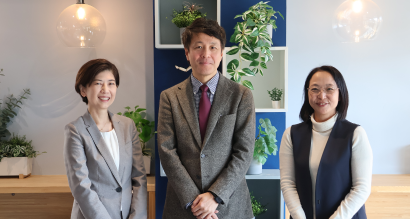
From left: Professor Ninomiya, Professor Morito, Professor Hayashi
Department of Nursing Faculty of Nursing, and Department of Physical Therapy and Department of Social Work Studies in Faculty of Social Work Studies Social Welfare Studies will take a new step forward as a single new faculty, the Faculty of Health Sciences Health Sciences, in April 2026. We interviewed Professor Ayako Ninomiya (hereinafter referred to as "Ninomiya"), current Head of Department of Nursing Faculty of Nursing of Nursing, Professor Takeshi Morifuji (hereinafter referred to as "Morifuji"), Head of Department of Physical Therapy Faculty of Social Work Studies, and Professor Wakako Hayashi (hereinafter referred to as "Hayashi"), of Faculty of Social Work Studies Department of Social Work Studies of Social Welfare Studies, about the Faculty's attractions, characteristics, and student atmosphere.
Please tell us specifically what benefits will be gained by integrating the previously separate fields of "health, medicine, and welfare" into the new "Faculty of Health Sciences."
Kan NinomiyaI have experience as a visiting nurse, where I received great care from many caregivers, welfare workers, and physical therapists. What was important to me at the time was face-to-face interaction, getting to know them, and having them get to know me. I think it's wonderful that by joining the Faculty of Health Sciences, students will naturally be able to do this. As a result, I believe the quality of medical care will surely improve and become a strength for students. I also think it's important not to try to do everything yourself, but to rely on each person's appropriate skills and expertise. I believe it's very important to learn about "interprofessional collaboration" so that you know who to ask when you're in trouble and can use your own expertise. By combining the three departments into the Faculty Health Sciences, I hope that students will naturally begin to interact with each other, make many friends through lively discussions, and create a fun atmosphere.
Please tell us about the atmosphere and characteristics of students in each department.
Morito: Many students in Department of Physical Therapy have experience playing sports. There are a relatively large number of active and energetic students, but there are also students who think things through and act carefully, so there are all kinds of students. However, one thing that is consistent is that since the work is related to rehabilitation, the department has many earnest, kind students who enjoy interacting with people.
Fukubayashi: Many students in Department of Social Work Studies are interested in interacting with people. When asked what motivated them to study welfare, I often hear students talk about how they have been helped by someone in the past, or how they have helped someone and been thanked for it, or how they felt frustrated because they were unable to help. When we hold events or activities within the department, there are many students who are happy to help if asked. This department has many such kind and active students.
Kan Ninomiya: There are many kind and earnest students in Department of Nursing as well. For example, if someone gets sick during a class and starts to feel a bit unsteady, everyone will call out, "Are you OK?" If there is a student who is feeling unwell somewhere, they will immediately call out, "Teacher, it's Mr./Ms. XX..." This department is full of students who love people and have the kindness to cooperate with each other.
What are the characteristics of learning in the Faculty of Health Sciences compared to other universities and existing faculties?
Morito: Department of Nursing, Department of Social Work Studies, and Department of Physical Therapy will all become one team. I think this will create an environment where students will naturally learn from an early age that each profession supports the other to support the target population and patients. We have already held joint classes together as part of interprofessional education, and have held discussions to get a hands-on understanding of each profession. Normally, students only learn more about each profession once they start working, but being able to learn about the characteristics of each profession while still a student will be an advantage once they start working.
Furthermore, as our university is an international university, we have an environment where you can study languages other than English. In addition, we have opportunities for overseas training, and I believe that being exposed to different ways of thinking, cultures, and diversity from an early age will be an advantage of the Faculty of Health Sciences.
What are the benefits of studying at the Faculty Health Sciences at International University of Japan?
Fukubayashi: Well-being is a common keyword in the School of Health Sciences. Well-being refers to the happiness and health of people's lives. Even when considering just one concept of happiness, what makes someone happy varies from person to person. I believe that an environment where you can learn an international sensibility is extremely important in understanding this diversity. By going to other countries and regions and learning about their cultures, you can break free from fixed ideas and stereotypical biases, and encounter things that are commonplace in your own life and completely unthinkable in our common sense. I believe that doing so will allow you to understand others with a broader perspective.
Our university's environment is also extremely favorable for learning international perspectives. For example, we have a large number of international students. Students interact with them in class, but I've also heard that they also participate in club activities together with international students. One student told me that when they interacted with students from countries they knew about through news reports and other media, they heard their opinions as real people living in those countries, and that there were other aspects to them that you couldn't see in the news. This allowed them to learn a balanced way of thinking that wasn't limited by the media reports.
I believe that such experiences will be extremely useful in developing the ability to understand the happiness of others, which is necessary for students in the Faculty of Health Sciences. During the course of your studies in the Faculty of Health Sciences, you will have to be there for people who are facing various illnesses, disabilities, and hardships in their daily lives. I believe that by studying in this international environment, you will develop the ability to imagine and empathize with people who are struggling in ways that are beyond your own common sense.
Morito: There are not many international students in nursing, as there are in science. Being able to discuss with international students in such settings will help students become more international on campus. I think this will be a great environment for us. I also hope that there will be more opportunities for students to naturally interact with each other outside of class, even in situations where faculty members are not involved.
Kan Ninomiya: After graduating from university and entering the workforce, you will work as a medical professional with people from many different countries, and you will naturally be able to interact with people who are not Japanese.

What skills do you want students studying in the Faculty Health Sciences to acquire that are common to all departments?
Kan Ninomiya: As we specialize in treating patients and other people, "communication skills" are extremely important. By "communication skills" I don't just mean being able to speak well. Rather, I think it's important to be able to "listen" well to what people say. It's about how well you can listen to what the other person is feeling and draw out their needs. This will enable you to provide care that meets their needs. At the same time, patients are very anxious, so I would like you to acquire the kind of communication skills that will help ease that anxiety, even if just a little.
Based on your area of expertise, what state do you consider to be "healthy"?
FukubayashiIn the School Health Sciences, health is not just physical health, but also psychological health and social well-being. I particularly emphasize the importance of social well-being. Being socially well-being refers to connections with others, having a place in society, and fulfilling a role. One study compared mortality rates with the three factors of "nutrition," "exercise," and "social participation," and found that there was a significant difference in mortality rates between those who participated in social participation and those who did not. This shows that social participation plays just as important a role in health as exercise, nutrition, and diet. I emphasize the importance of social participation to students studying welfare in my classes. I believe that ways of participating in society and connecting with others vary from person to person. However, no matter what your condition, I always encourage you to think about the role you should play in order to create opportunities to interact with society and experience things that interest you, so that you can do what you want to do.
Morito: Health refers to a healthy state of mind and body, but being able to freely go where you want, eat what you want, meet people you like, and do these things makes you feel happy. As Dr. Hayashi just mentioned, I also believe that social interaction plays a major role in health. As a physical therapist, my job is to support people in acquiring physical movement and action, encouraging them to participate in society. In reality, it is difficult to ensure that all patients' bodies recover to their full potential, but I believe that society as a whole must support this. As Dr. Hayashi said, there are limits to what patients, physical therapists, and medical staff can do. I believe that for everyone to be healthy, society as a whole must support health.
Kan NinomiyaNursing targets a truly diverse range of people, at various stages in their lives. I would like to consider health from the perspective of end-of-life care, which is my Research topic. Health is the ultimate desire of humans from birth to death, and we all want to live as healthily as possible until the moment of our death. When it comes to end-of-life care, I think keywords such as "preserving dignity" and "peacefully and pain-free" will come up. Health, of course, means not being sick or weak, but I also think that having one's dignity protected, being valued as a person, and being able to maintain a sense of peace are also elements of health.
In terms of collaboration between departments and Research schools, what form do you envision in the future?
Morito: First of all, in terms of education, we are already conducting joint classes, connecting with each other through interprofessional collaborative education, and holding joint discussions, and we are promoting collaboration. We are also working to increase the number of joint classes in the future. We also want to create overseas training programs that cross departments.
In addition to teaching, faculty members are already working together on joint Research. A professor from Department of Physical Therapy who is conducting Research with a professor from Department of Nursing said that he is able to broaden and deepen Research by learning perspectives that he would not have thought of on his own.
Our university also has two graduate schools Graduate School of Health Sciences and Graduate School of Social Work Studies. Graduate School of Social Work Studies has been around for some time, and many of its graduates are active in their fields. However, the Graduate School of Graduate School of Health Sciences Sciences only just opened in 2023. Some students who have studied for four years at university take special Research in the curriculum of the Graduate Research Graduate School of Health Sciences and go on to the Graduate Graduate School of Health Sciences. We hope that this trend will continue to grow in the future.
I believe that many people, not only graduates of Graduate School of Health Sciences and Graduate School of Social Work Studies, but also medical professionals active in the local community and those working in the welfare field, have questions about their work. I believe that people with such clinical questions need a place to investigate them, even if they are not graduates of our university. As there are currently not many Research institutions in the area surrounding our university, I believe that providing a place where medical professionals and welfare workers working in the local community can conduct Research is also a major mission of our university.
What kind of achievements do you hope students who graduate from the Faculty Health Sciences will have?
Fukubayashi: Going forward, Japanese society will increasingly need people with expertise in the field of Health Sciences to support health and daily life. What you learn in the Faculty Health Sciences will not be a passing fad, but will become a skill that will be needed in all areas of society in the future. I hope that you will be active in a variety of fields, not just in the fields of medicine and welfare, but without being bound by fixed ideas. I believe that society of the future will not be bound by a single idea of what it must be like, but will be able to be active in a wide range of fields, for example, by collaborating with fields that use AI and ICT. I hope that young people will take on challenges with their own unique perspectives and new ideas, and be active not only on the front lines of medicine and welfare, but also in a variety of companies, communities, education, and Research fields.
While it is often thought that studying in the School of Health Sciences is all about doing one's best for others, it is also a field of study that allows one to grow and enrich oneself. I hope that students will use the empathy and expertise they have acquired in the School Health Sciences to support society while also enriching their own lives.